

How to build an emergency fund, even on a tight budget
An emergency fund is money you set aside only for the unexpected: losing your income, an urgent repair, a medical bill. To build an emergency fund, aim for three to six months of essential expenses, kept apart from your everyday money in an account you can reach within a day or two. It’s what stops the next surprise from going on a credit card.
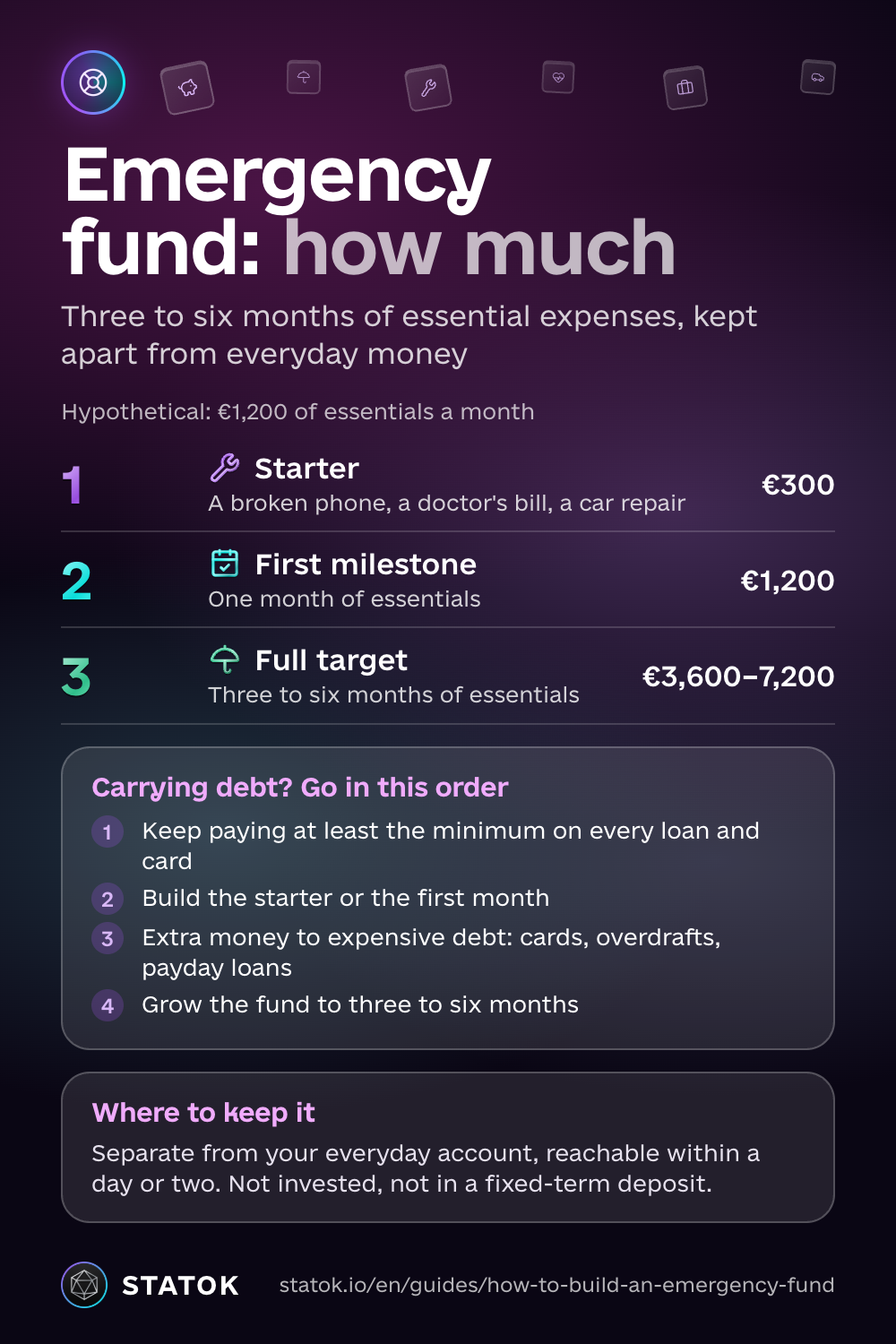
You don’t need it all at once. Start with one month of essentials, or a smaller starter if that’s out of reach, move a fixed amount every payday, and refill whatever you use. A hypothetical example: if your essentials come to €1,200 a month, your first milestone is €1,200 and the full target is €3,600 to €7,200.
How much should be in an emergency fund
Step 1. Add up your monthly essentials
Count only what you’d still have to pay if your income stopped tomorrow: rent or mortgage, utilities, groceries, transport to work, phone and internet, insurance, minimum debt payments, medicines and childcare. Leave out the wants, like eating out, streaming and holidays.
If you don’t know the number, go through last month’s bank statement, or track a month or two first. Here’s how to track your spending without typing every purchase.
Step 2. Choose how many months
Three months suits a steady salary in a household that doesn’t rely on one income. Aim for six or more if your pay is irregular (freelance, commission, seasonal work), you’re the only earner, someone depends on you, or jobs in your field take a while to find.
Some advice counts in months of salary, some in months of expenses. Expenses are the better yardstick, because the fund has to pay your bills, not replace your whole paycheck. It also gives a smaller number, which is easier to start on.
Step 3. Multiply
Back to the hypothetical €1,200 of monthly essentials:
| Stage | What it covers | Amount |
|---|---|---|
| Starter | A broken phone, a doctor’s bill, a car repair | €300 |
| First milestone | One month of essentials | €1,200 |
| Full target | Three to six months of essentials | €3,600 to €7,200 |
How to build an emergency fund when money is tight
Aim for one month first. Three to six months of costs can feel out of reach, which is why many people never start. One month is a real milestone. If even that is too far, start with the starter amount: enough for a broken phone or a car repair without borrowing.
Pay yourself first. Move the money on payday, not at the end of the month when nothing’s left. An automatic transfer, if your bank offers one, means you don’t have to remember. At €100 a month, the first €1,200 takes about a year. That’s normal: small and steady beats big and occasional.
Add windfalls. A tax refund, a bonus, birthday money. Even part of it moves the fund along faster.
Find the money in your budget. Subscriptions you no longer use are the easiest place to look: here’s how to find and cancel forgotten subscriptions. If you split your pay with the 50/30/20 rule, the fund comes first inside the 20% for savings.
If nothing is left after essentials, don’t cut rent, food or bills to save. Pause the fund, look at your budget first, and use the free help listed below if the gap keeps coming back. When there’s a little room again, even €5 a week builds the habit.
Emergency fund or debt first?
If you carry debt, go in this order:
- Keep paying at least the minimum on every loan and card. Missed payments add fees and can hurt your credit record.
- Build the starter or the first month, so the next surprise doesn’t go on the card and grow the debt.
- Then put extra money toward expensive debt: credit cards, overdrafts, payday loans, and buy now, pay later plans you’ve fallen behind on. Their interest usually costs more than savings earn, and paying only the minimum keeps the interest running. The debt snowball or avalanche method is one structured way to decide which balance to pay off first.
- Then grow the fund to three to six months, then save for goals, and only after that think about investing.
Behind on payments, or can’t pay? Contact the lender before the due date, and don’t borrow to cover the gap. In the US, the CFPB explains how to find a reputable nonprofit credit counselor. In the UK, the MoneyHelper debt advice locator finds free, confidential debt advice.
Where to keep your emergency fund
- Separate from your everyday account, so it doesn’t get spent by accident. A second account at your own bank is fine.
- Reachable within a day or two, with no risk of losing part of it: an ordinary savings or instant-access account in the currency you spend, at a bank covered by deposit insurance.
- Not invested. Stocks and funds can fall exactly when you need the money, for example in a downturn that also costs you your job. The fund’s job is to be there, not to earn.
- Not locked away in a fixed-term deposit you can’t break without a penalty.
- Not all in cash at home. A small amount is fine, but the CFPB reminds you that cash can be stolen, lost or destroyed, so keep the bulk in an account.
What counts as an emergency, and how to refill it
Use it for: lost or reduced income, urgent health costs, an essential repair (the boiler, the fridge, the car you need for work), or a trip you can’t avoid, such as a family emergency.
Don’t use it for: sales, holidays, gifts, or yearly bills you know are coming, like insurance renewals, car tax or school costs. Those aren’t emergencies, they’re irregular. Give them their own savings goal and put a little aside each month.
After you use the fund, refilling it comes first, before other goals, at the same amount per payday. The CFPB puts it simply: if you spend it down, work to build it up again. Recheck the target once a year, or whenever your rent, family or income changes.
How STATOK does it
Adding up your essentials, watching a separate balance and remembering to top it up every payday is a lot to keep in your head. In STATOK, it lives in one place.
- A goal for the fund. In Control, tap + at the end of the Goals row (or Set your first goal if you don’t have one yet), name it and set the Target amount: your essentials times the months you chose. Add a target date if you like, and the goal shows whether you’re On schedule or Behind schedule.
- Progress that follows the real balance. In the same form, pick the separate account where the fund sits as the Linked account. The goal’s progress then moves with that account’s balance, with no manual updates. If the account holds other money too, you can count just a share of its balance.
- Reminders and milestones. Set Remind me to contribute to Weekly, Every 2 weeks or Monthly to match your payday. If notifications are on, STATOK also tells you when you pass 25%, 50% and 75%, and when you reach the goal.
- A quick reality check. In the Aura tab, Financial health includes a Cash reserve line, such as “Lasts 3.4 months of spending”. It compares the money on all your accounts with your average total spending over the last three months, so it’s a rough gauge, not your essentials target. It’s free and needs about a month of transactions first.
The essentials number from Step 1 comes from your records, and you don’t have to type them: log spending by voice, by scanning a receipt, by importing a statement as Excel, CSV or PDF, or let the Shortcuts app log iPhone payments and bank notifications (iOS 27). The Free plan includes a limited number of goals and has limits on voice entries, scans and imports; Pro is unlimited.
Read next
- The 50/30/20 rule: where the emergency fund fits when you split your pay.
- How much can I spend per day: a daily limit that keeps everyday spending away from the fund.
- How to track your spending: the records behind your essentials number.
- How to calculate your net worth: your emergency fund is often the first real asset on that list.
Save this guide
Download as an image Download as an image Download as an image