


How to Calculate Your Net Worth (Step by Step)
To calculate your net worth, add up everything of value you own, subtract everything you owe, and what’s left is the number. It’s the one figure that captures your whole financial picture, not just the income that lands each month or the balance sitting in your checking account right now.
Net worth isn’t a scoreboard against anyone else. There’s no passing grade and no deadline to hit. Think of it as a personal before-and-after: the number you’re really comparing it to is your own, from a few months back.
What counts as an asset, what counts as a liability
Assets are anything you own that has value:
- Cash in checking and savings accounts
- Your emergency fund, if you’ve started one
- A home or other property you own
- Your car, at what it’s actually worth today, not what you paid for it
- Investments and retirement accounts
Liabilities are everything you owe:
- A mortgage balance
- A car loan
- Credit card balances you carry from month to month
- A personal loan
- Any buy now, pay later balance you still owe
A buy now, pay later plan goes on the liabilities list like any other debt, even if it doesn’t feel like a loan. If you’re not sure where your money actually goes each month, tracking your spending for 30 days is usually the fastest way to get real numbers for both lists.
How to calculate your net worth (3 steps)
Step 1. List your assets at today’s value
Go account by account and write down the current balance, not the number you wish it were. For a house or a car, use a realistic value today, not what you paid for it. An emergency fund, if you have one, is often the first real asset on this list.
Step 2. List your liabilities at today’s balance
Same approach: the balance you’d owe if you paid it off today, not the original loan amount and not the monthly payment.
Step 3. Subtract
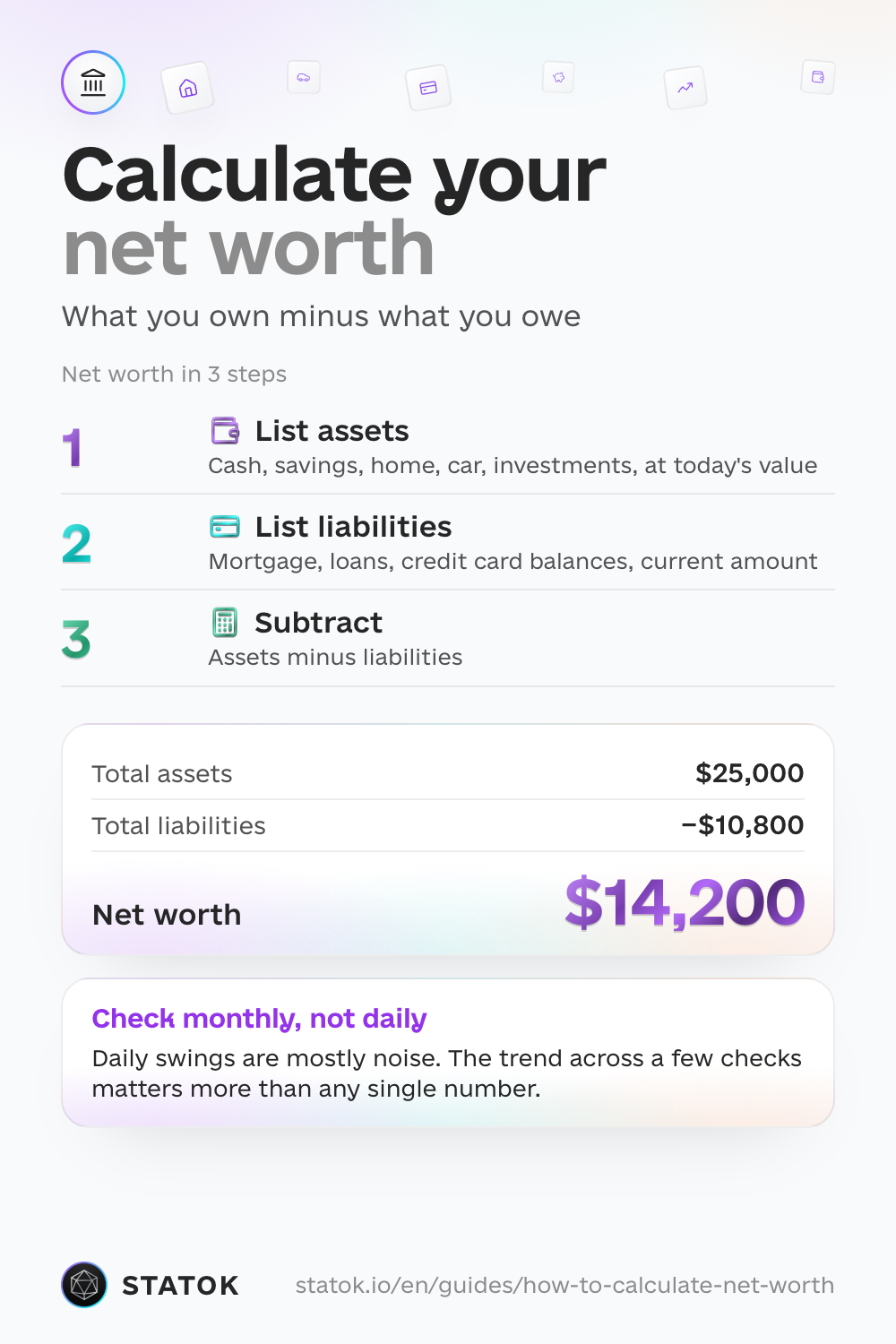
Assets minus liabilities. That’s your net worth.
Here’s a hypothetical example, just to see the shape of the math:
| Assets | Value |
|---|---|
| Checking and savings | $8,000 |
| Car (current value) | $12,000 |
| Investments | $5,000 |
| Total assets | $25,000 |
| Liabilities | Balance |
|---|---|
| Car loan | $9,000 |
| Credit card | $1,800 |
| Total liabilities | $10,800 |
$25,000 minus $10,800 leaves $14,200 net worth. That’s a made-up example, not a target: your own numbers will look nothing like it, and that’s fine.
How often to check your net worth
Once a month or once a quarter is enough. Checking daily mostly shows you noise: a paycheck that hasn’t cleared, a card statement that hasn’t closed yet, an investment that moved 2% overnight. If you want to get your monthly numbers straight first, MoneyHelper’s free budget planner walks you through income and outgoings.
Pick a day you’ll remember, like payday or the first of the month, and recalculate then. The trend across a few checks matters far more than any single reading.
A negative number is a starting point, not a verdict
Plenty of people start below zero: right after college, after a big medical bill, after a layoff. A negative net worth isn’t a character flaw. It’s just where the math lands today.
If your liabilities include high-interest debt (credit cards, overdrafts, or a buy now, pay later balance you’ve fallen behind on), make paying it down your priority once you have a small cushion for emergencies, and before investing. The debt snowball or avalanche method is one structured way to decide which balance to attack first. Paying a debt off from savings won’t change today’s number, because both lists shrink by the same amount. What it does is stop the interest eating into it, so the number climbs faster from then on. Keep covering essentials and at least the minimum payment on everything else while you do.
Behind on payments, or can’t pay? Contact the lender before the due date, and don’t borrow to cover the gap. In the US, the CFPB explains how to find a reputable nonprofit credit counselor. In the UK, the MoneyHelper debt advice locator finds free, confidential debt advice.
How STATOK tracks your net worth for you
Updating two lists and doing the subtraction every month gets old fast, especially once you have more than a couple of accounts. Tap Net worth at the top of the Home screen, or the total itself, to open the screen that keeps that running total for you.
- Accounts, cards and assets in one place. Add your accounts and cards, then add everything else by hand: a home, a car, a mortgage, a loan. Each item has an Include in net worth switch, so you can keep it in your records without counting it in the total, say a car you’re about to sell.
- Payoff reminders. Add a mortgage or a loan as a liability, set its Payoff date, and under Remind me before payoff choose how many days ahead STATOK should notify you. It stays off until you pick.
- Forge into gold. When your total is positive, tap the pickaxe icon under it (VoiceOver calls it “Forge into gold”) and STATOK recasts the sum as gold bars at the latest gold price, with the price date shown. A small reward for checking in. It needs a plus to work with: at zero or below there’s nothing to forge.
- The trend, not just today’s number. Tap Details for a Monthly Trend chart of the last 6 months, and the Home screen shows how much the total moved this month.
The accounts in that total update themselves as transactions come in, however you log them: by voice, by scanning a receipt, by importing a statement as Excel, CSV or PDF, or by letting the Shortcuts app log iPhone payments and bank notifications (iOS 27). Assets like a house or a car you still add by hand, since no bank statement knows what your car is worth today. The Free plan includes a limited number of accounts; Pro removes that limit.
Once you’ve got a number, the 50/30/20 rule is one way to make sure the savings slice of your budget keeps moving it in the right direction, month after month.
Read next
- How to build an emergency fund: the first cushion that protects your net worth from a surprise bill.
- How to track your spending: where your money goes, and so how much of it you can set aside.
- The 50/30/20 rule: a way to split your pay that gives saving a fixed place.
Save this guide


Download as an image Download as an image Download as an image