

Debt Snowball vs Avalanche: Which Should You Use?
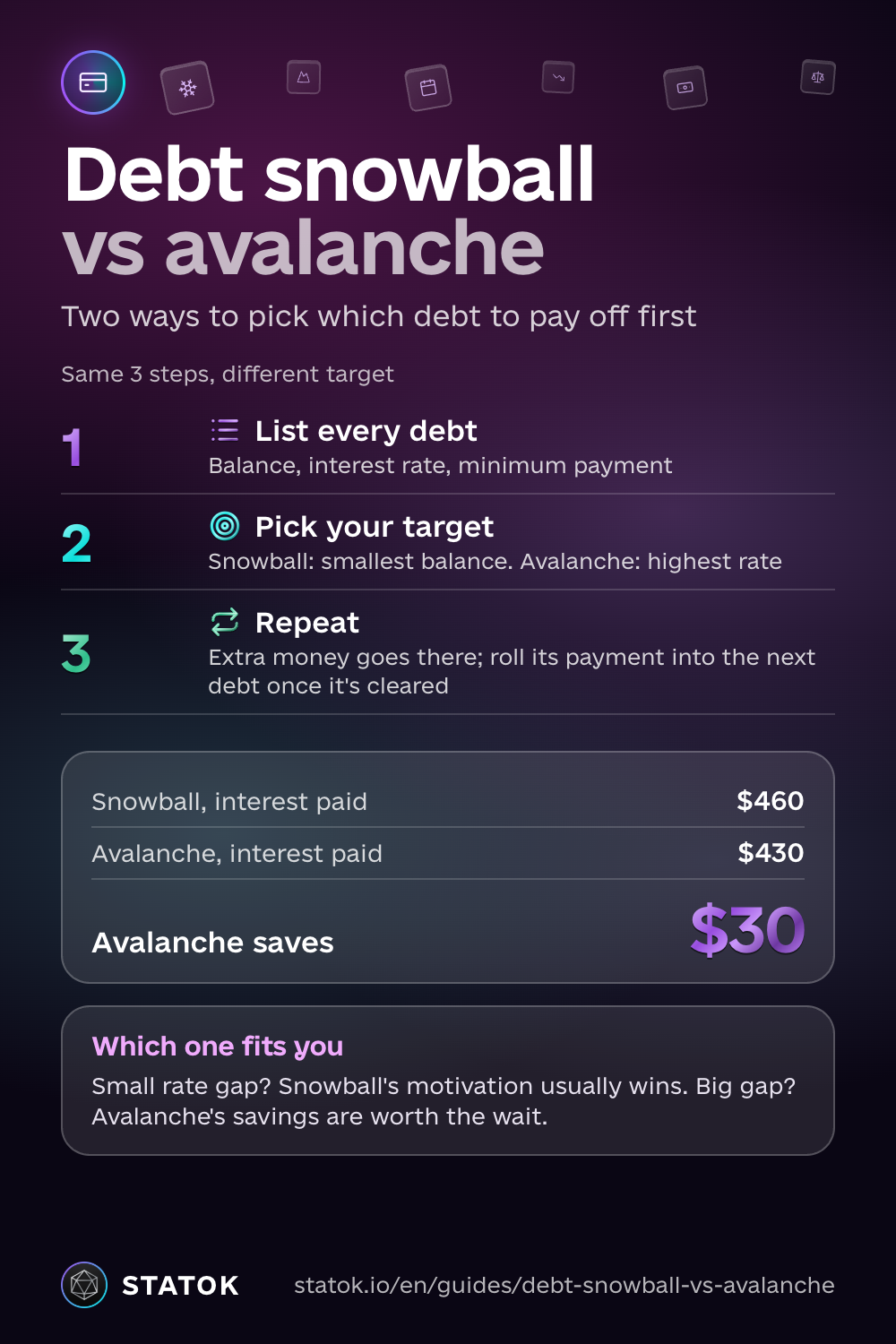
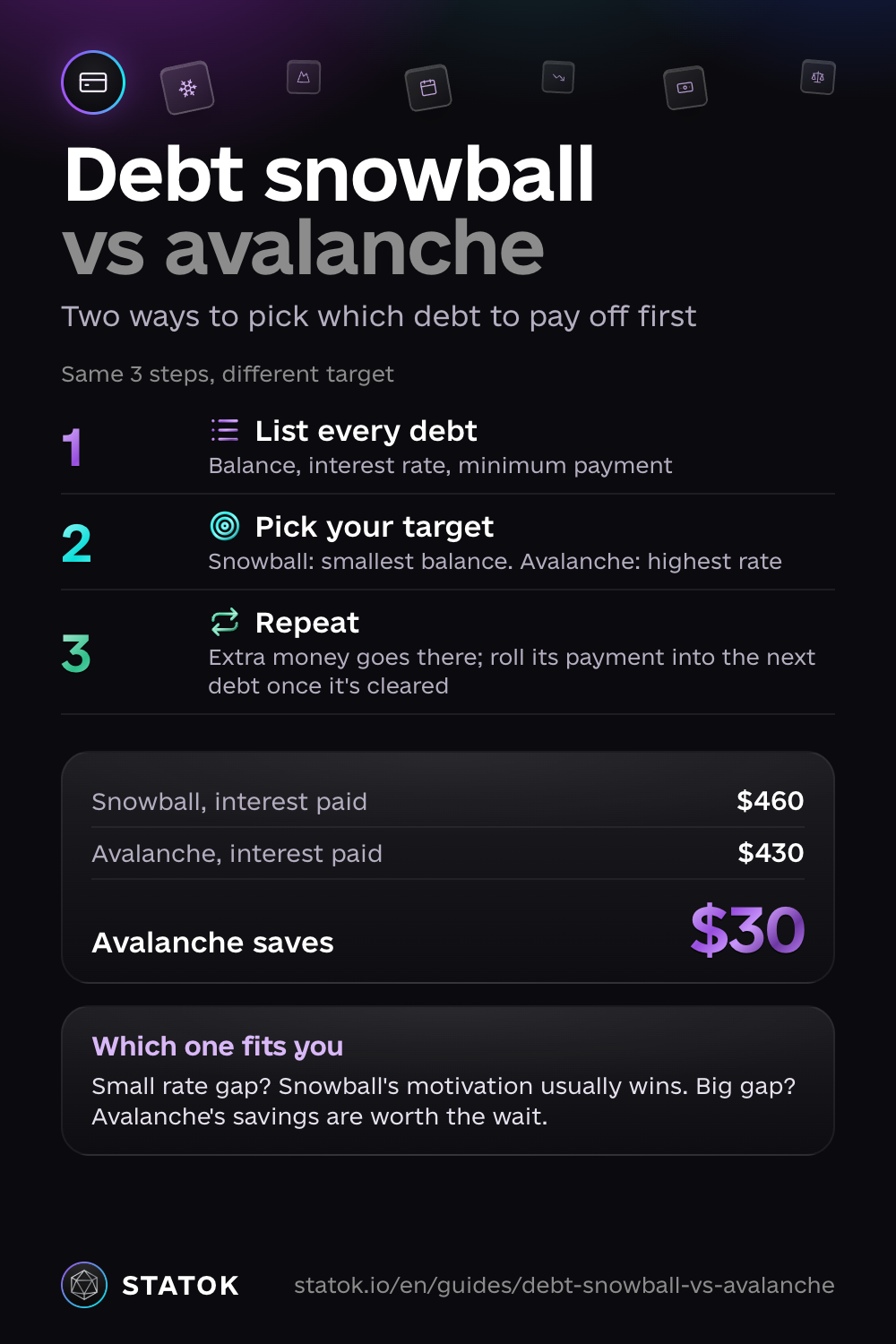
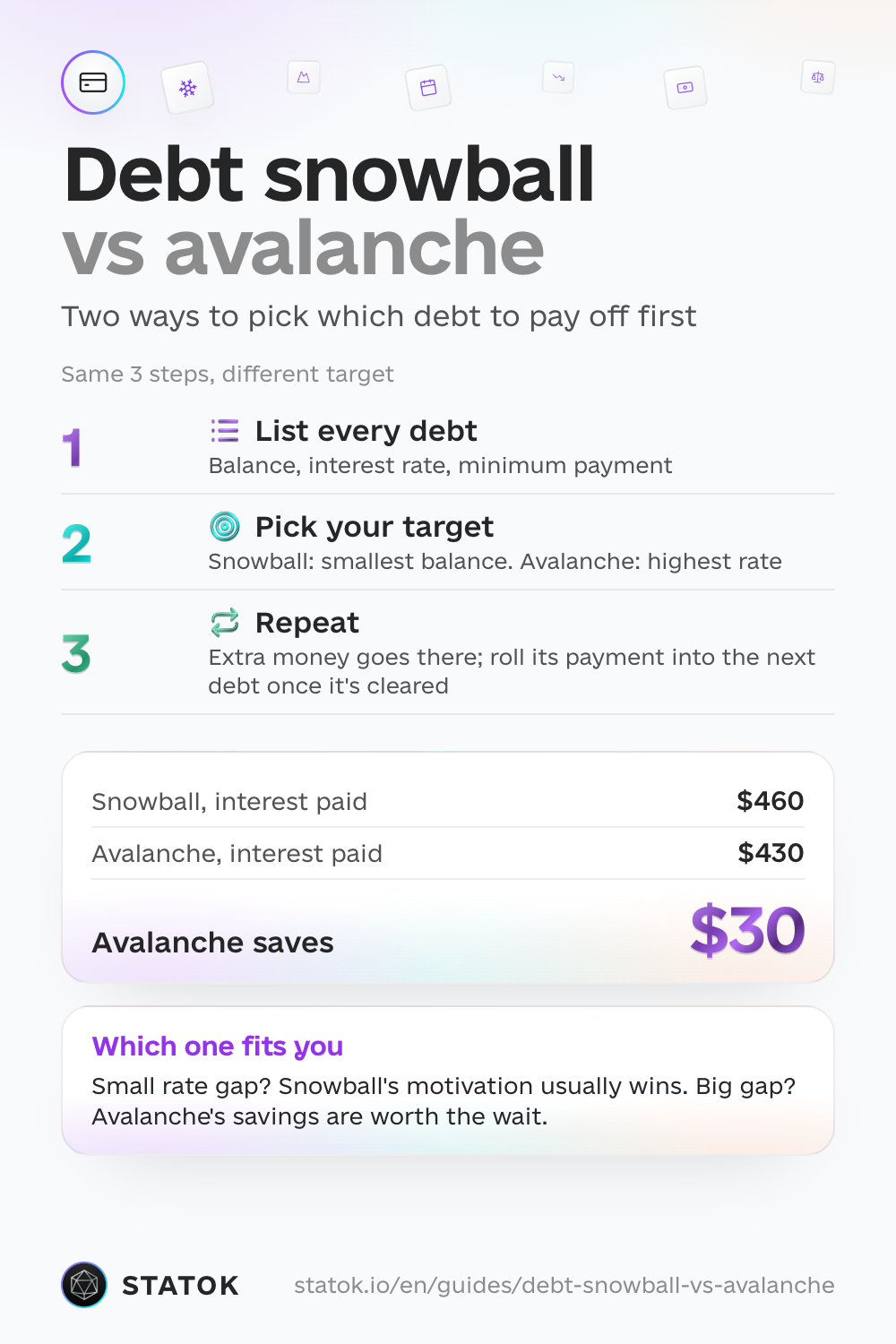
The debt snowball pays off your smallest balance first, no matter its interest rate, so you get a quick, motivating win. The debt avalanche pays off the balance with the highest interest rate first, so you pay the least total interest. Both keep at least the minimum payment on every other debt the whole time: neither method ever means skipping a payment somewhere else.
So which is better, debt snowball vs avalanche? The math favors avalanche. The motivation usually favors snowball. The CFPB puts it simply: choose the strategy that’s best for your situation. In practice, that’s the one you’ll actually keep doing every month, not the one that looks best on paper.
How each method actually works
Both start the same way:
- List every debt with its balance, interest rate and minimum payment.
- Pick your target. Snowball targets the smallest balance. Avalanche targets the highest interest rate.
- Send every spare dollar to that one debt, while paying the minimum on everything else. When the target hits zero, roll its whole payment (minimum plus extra) into whichever debt is next on your list.
Here’s a hypothetical example, just to see the mechanics. Say you’re carrying three debts and have $200 a month free to put toward extra payments:
| Debt | Balance | Interest rate | Minimum payment |
|---|---|---|---|
| Credit card A | $1,500 | 24% | $100 |
| Credit card B | $1,000 | 15% | $50 |
| Car loan | $4,000 | 8% | $150 |
Snowball targets card B first, the smallest balance. With $200 extra plus its $50 minimum, that’s $250 a month, so card B clears in about 4 months. Everything else keeps getting its minimum the whole time.
Avalanche targets card A first, the highest rate. With $200 extra plus its $100 minimum, that’s $300 a month, so card A clears in just over 5 months, a bit slower for the first win, but the 24% card, your most expensive debt, stops charging interest sooner.
Run both to the end and, in this made-up case, avalanche costs about $30 less in interest; both finish in month 14. A gap that small is exactly when snowball’s quick win is worth it.
Either way, the car loan stays at its $150 minimum until one of the cards is gone, then its turn comes. This is a made-up example to show how the order works, not a prediction of what you’ll pay off or by when.
A common middle ground, sometimes called a “debt blizzard”: clear one or two genuinely tiny debts with snowball first for the early win, then switch to avalanche for whatever’s left.
Debt snowball vs avalanche: which one fits you
If the interest-rate gap between your debts is small, a couple of percentage points, the money you’d save with avalanche is small too, and snowball’s motivation usually wins in practice: you clear something, you feel it, you keep going.
If the gap is large, a revolving card sitting at 20%+ next to a loan at mid-single digits, avalanche’s savings are real enough that the slower first win is worth it. There’s no wrong choice here, and no reason to feel bad about picking either one.
Before you pick a method: the order that keeps you safe
A payoff method is about the extra money on top of your minimums, never about skipping a minimum to free up cash. That order matters more than which method you pick:
- Essentials and every minimum payment, always. Rent or mortgage, utilities, food, getting to work, and the minimum on every single debt come before any extra payment to anyone.
- A small emergency cushion first, even just one month of essential expenses, so a surprise bill doesn’t force new borrowing the moment you start throwing extra money at debt.
- Then the extra payments, snowball or avalanche, on top of what’s already covered.
A buy now, pay later balance you’re behind on belongs on this list exactly like a credit card, even if it doesn’t feel like a loan. The CFPB’s guide to reducing debt describes both methods and keeps the minimum on every debt. In the UK, MoneyHelper tells you to deal with priority debts first: rent or mortgage, council tax and energy, where falling behind has the most serious consequences.
If you can’t make even the minimum
Contact the lender before the due date, not after; many will adjust a payment plan if you ask early. Don’t take out a new loan or open a new card to cover the gap; that usually adds a second problem on top of the first. In the US, the CFPB explains how to find a reputable nonprofit credit counselor. In the UK, the MoneyHelper debt advice locator finds free, confidential advice near you.
How STATOK helps you follow through
Keeping three or more balances, rates and minimums straight in your head, or updating a spreadsheet by hand, is usually where a snowball or avalanche plan quietly stalls. STATOK’s Net Worth screen holds that list for you.
- One list for every debt. Add each loan, buy-now-pay-later plan or other debt once, with its current balance. It goes under Liabilities, alongside a mortgage or car loan. Credit cards you already track as accounts in STATOK are counted already, so don’t add them again.
- A payoff date and a reminder. Open any liability and set its Payoff date (it starts one month out, so change it to the day you expect to clear the debt), then under Remind me before payoff pick 1, 3 or 7 days, or a month, ahead. It’s off until you pick one.
- Ask Aura which debt to tackle first. In the Aura chat, ask “How can I pay off my debts faster?” Aura answers from the debts you’ve added, with their balances and payoff dates. STATOK doesn’t store interest rates, so tell Aura each debt’s rate if you want the avalanche order. On Free, Aura has a daily message limit; Pro is unlimited.
- A health score that counts card debt. Aura’s financial health score, out of 100, is free. One of its lines, Credit debt, adds up what you owe on credit cards and overdrafts you track as accounts in STATOK, and it rises as that balance comes down. It sits alongside savings rate, budgets kept and a few other factors, once there’s about a month of transactions.
Debt balances don’t update themselves: after each payment, open the debt and type in the new balance. Your day-to-day spending is different. It doesn’t have to be typed in: log it by voice, by scanning a receipt, by importing a statement as Excel, CSV or PDF, or let the Shortcuts app record iPhone payments and bank notifications (iOS 27). That’s how you see where the extra money for your target debt can come from, and it keeps card balances (and the Credit debt line) current. The Free plan limits how many accounts you can add; Pro removes that limit.
Read next
- How to build an emergency fund: the small cushion that should come before extra debt payments, not after.
- How to calculate your net worth: the same liability list this guide uses lives on that screen.
- The 50/30/20 rule: where the extra money for either payoff method usually comes from inside your budget.
Save this guide

Download as an image Download as an image Download as an image