

How much can I spend per day? Work out your daily limit
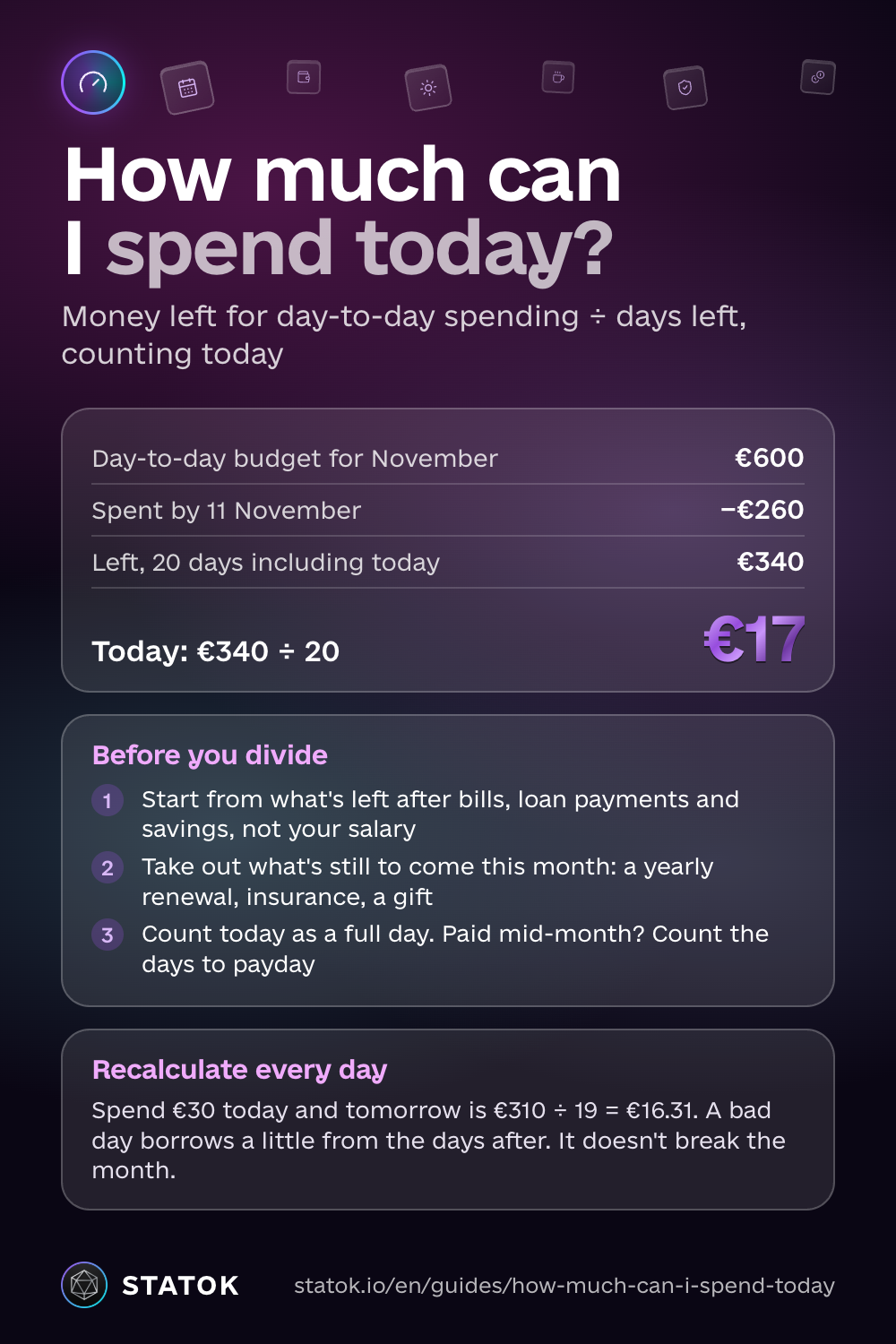
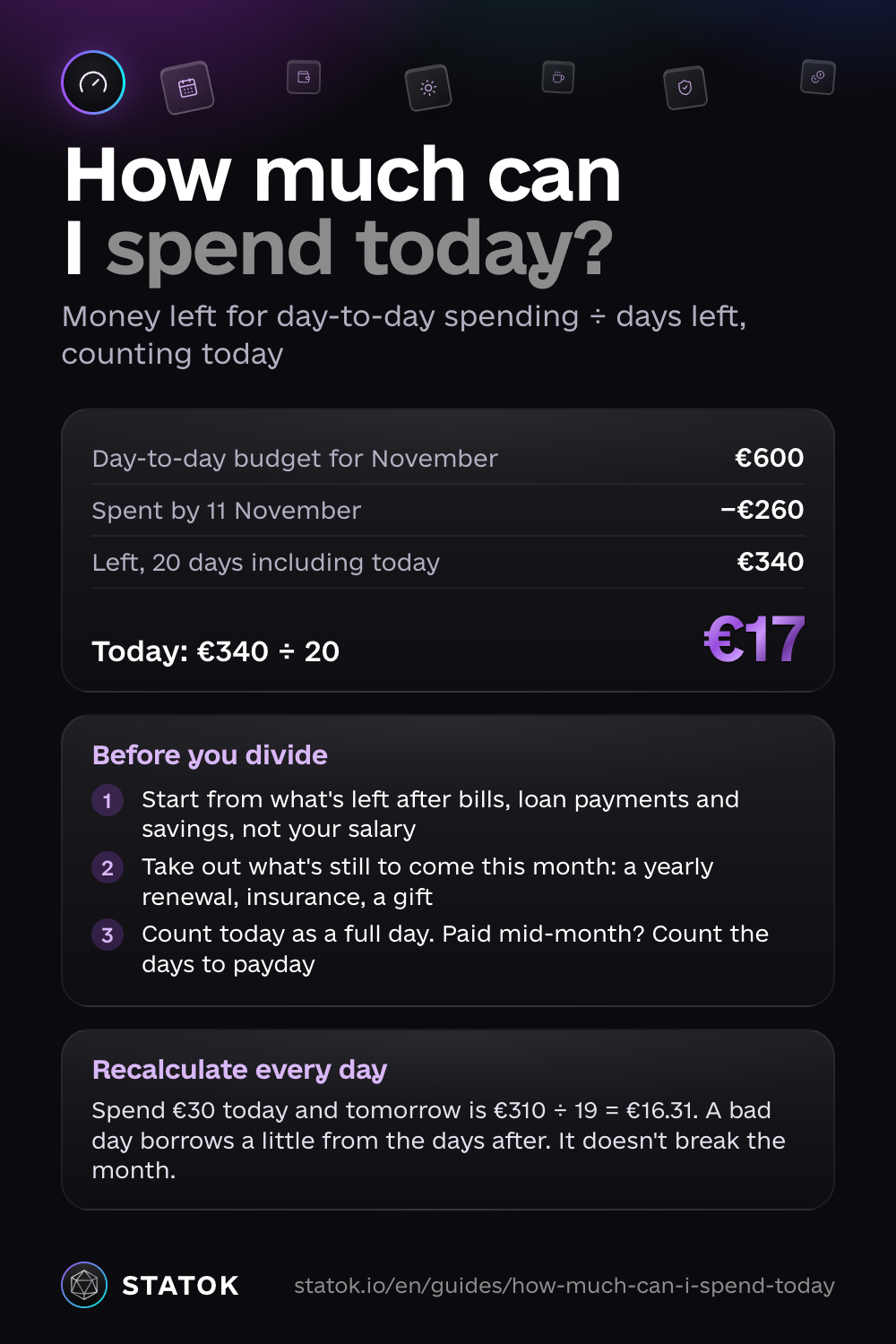
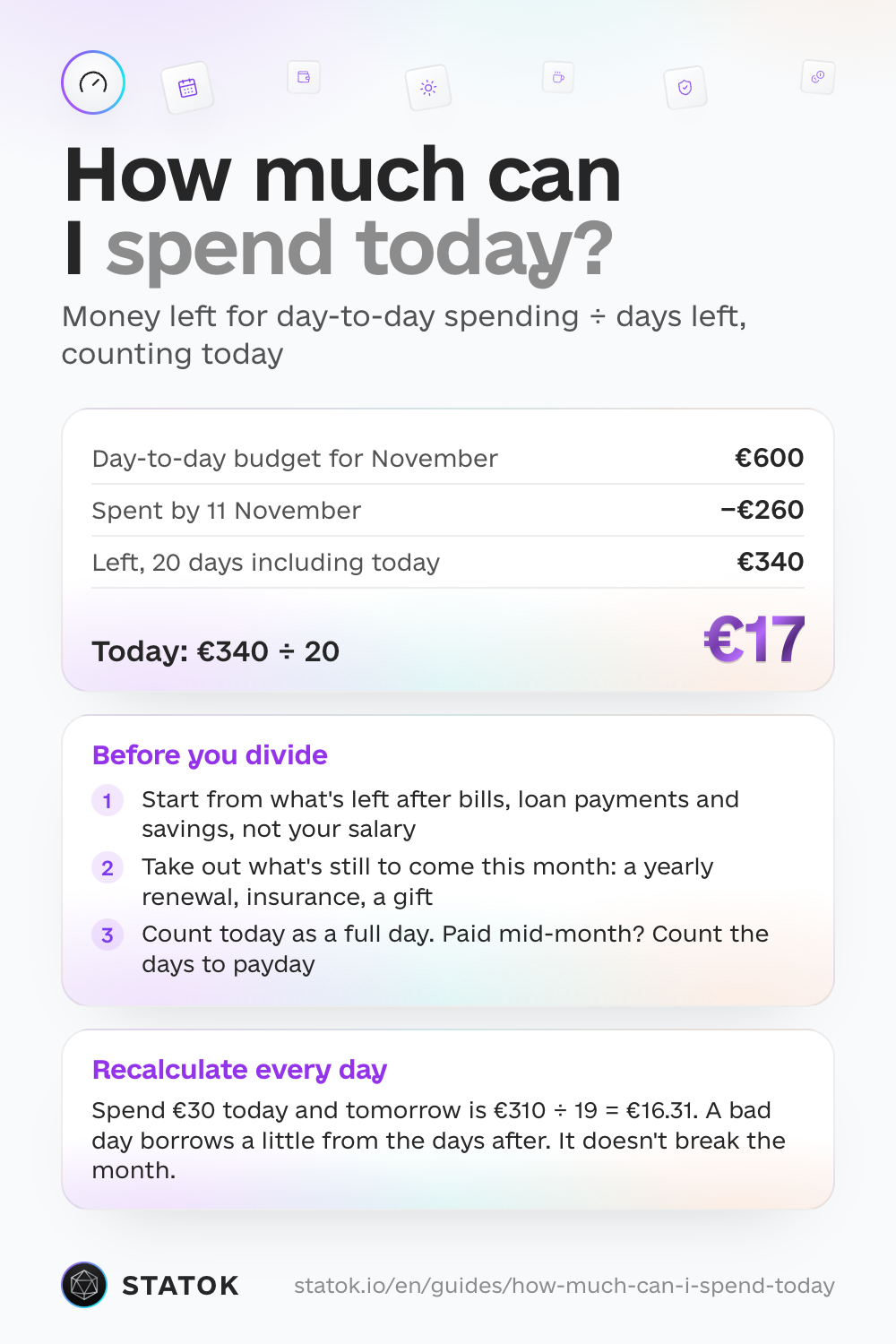
How much can you spend per day? Take the money left for day-to-day spending this month and divide it by the days left, counting today. Say your day-to-day budget for November is €600 and by 11 November you’ve spent €260. That leaves €340, and 20 days to go including today: €340 ÷ 20 = €17 for today.
The number is recalculated every day from what’s actually left. Spend less today and tomorrow’s figure grows a little; spend more and it shrinks. As long as you go by the new number each day, the month still ends on budget, which is the point.
How to calculate how much you can spend per day
Step 1. Start from money you can actually spend
Don’t start from your salary. Start from what’s left after fixed bills, loan payments and savings. A hypothetical example: €2,000 net pay, €1,000 for rent, utilities, phone and a loan payment, €400 into savings. That leaves €600 for everything else: groceries, coffee, transport, going out. The 50/30/20 rule is a good way to size this day-to-day part if you don’t have a budget yet.
If €400 a month is out of reach, start with whatever you can, even €20, and put it toward a small emergency fund first. One month of essentials is a good first target. If nothing is left after the bills, skip saving for now and read the section below on what to do when the number is too small.
Carrying credit card debt or an overdraft? Once that first cushion is in place, extra money goes to paying it down before other savings goals, because the interest usually costs more than savings earn.
Step 2. Take out what is still to come this month
Look ahead to the end of the month. Anything that hasn’t been paid yet and isn’t already in your bills has to come out before you divide: an annual subscription that renews this month, car insurance, a birthday present. If a €40 annual renewal lands on the 25th, take it out first: €300 ÷ 20 = €15 a day, not €17. Subscriptions are the easiest to forget, so check for the ones you’ve lost track of once a year.
Step 3. Divide by the days left, counting today
Count today as a full day. On 11 November there are 20 days left in the month, not 19. If you’re paid on another date, say the 15th, count the days to your next payday instead of the month’s end. That’s the stretch the money has to last.
The worked example
- Day-to-day budget for November: €600
- Spent by 11 November: €260
- Left: €340, 20 days including today
- Today: €340 ÷ 20 = €17
Notice that €600 ÷ 30 would have been €20 a day. You’ve been spending a little faster than planned, so today’s figure is lower. That’s the formula doing its job.
Why the number changes every day
Always recalculate from what’s left, never from your original daily figure. Say you spend €30 today. Tomorrow you’ll have €310 and 19 days: €310 ÷ 19 = €16.31. If you spend only €10, tomorrow it’s €330 ÷ 19 = €17.36.
A bad day doesn’t break the month. It borrows a little from each of the days that follow, and the formula spreads that cost for you. There’s no reason to give up on the budget because Tuesday went wrong.
A good day works the other way. The slack rolls forward into a slightly bigger number. Decide in advance what it’s for: a dinner at the weekend, or straight into your emergency cushion.
There’s a reason to take bills out first. A US study of app transaction data (Science, 2014) found that total spending rises about 70% on the day pay arrives, mostly because scheduled bills go out then. Leave the bills in your daily number and, right after payday, it will look like you have far more to spend than you do.
If the number is too small to live on
Sometimes the formula gives a figure that won’t cover food and getting to work, or the money is gone days before payday. That isn’t a budgeting failure. The money just doesn’t stretch to payday, and the order you deal with it in matters:
- Essentials first. From what’s left, set aside groceries and transport to work until payday. Only what remains after that goes on anything else.
- Cut the extras, not the bills. Spend less on things you can skip, and save less for a while. Keep paying rent, utilities and at least the minimum on every loan or card.
- Don’t borrow to get to payday. A payday loan, a bigger overdraft or buy now, pay later on groceries costs interest or fees and makes next month’s number smaller.
- Talk to anyone you can’t pay before the due date. Lenders, landlords and energy suppliers often offer a payment plan or a short delay, but usually only if you ask early.
- Get free help if it keeps happening. In the UK, MoneyHelper’s debt advice locator finds free, regulated debt advice near you. In the US, the CFPB has a tool for deciding which bills to pay first.
Common mistakes
Dividing the whole salary by 30
€2,000 ÷ 30 is about €67 a day. In the example above the real figure is €17. Rent, bills and savings take most of the salary before a single coffee, so the naive daily number is wildly optimistic.
Forgetting irregular and annual costs
Insurance, a dentist visit, gifts, a yearly subscription. They don’t show up every month, so they’re missing from a monthly budget built from memory. Keep a short list and check it at Step 2.
Counting to the end of the month when you’re paid on another day
If your pay arrives on the 15th, the money in your account on the 1st has to last until the 15th, not the 30th. Use the days to payday.
Mixing a big planned purchase into the daily number
A new laptop or a holiday doesn’t belong in day-to-day spending. Give it its own budget or savings goal, or it will wipe out your daily figure for weeks.
Daily, weekly or monthly limit?
A daily number suits steady spending: food, coffee, transport. If your spending is lumpy, for example one big grocery shop on Saturday, a weekly limit fits better. Use the same formula: money left for the week ÷ days left in the week. Many people combine the two, a weekly limit for groceries and a daily number for everything else.
How STATOK does it
STATOK does Step 3 for you, every day. Set a monthly, weekly or daily budget, either one budget for all spending or separate ones for categories like groceries, eating out and transport. Home then shows Can spend today with the amount available today. The math is the one from this guide: for each budget, what was left this morning, divided by the days left in its period including today, minus what you’ve spent so far today. The bar under the number fills as you spend. If you go over, the card switches to Over today’s plan.
What to know before you rely on it:
- It comes only from your budgets. It doesn’t look at your account balance and doesn’t subtract upcoming bills. Do Steps 1 and 2 when you set the limits. A single budget for all spending counts every expense, rent included, so set its limit to match. Budgets for day-to-day categories keep rent out of the picture.
- Periods follow the calendar. A monthly budget runs from the 1st to the last day of the month, a weekly one from Monday to Sunday. If you’re paid mid-month, a weekly budget is the closer fit.
- It’s on Home by default once you have a budget. If you’ve switched it, the ⇄ button opens Show first, where For today brings it back.
- Control shows the detail. Each budget shows its own Safe to spend amount, and the summary shows your pace, such as “€17 a day”. Budgets warn you before you hit a limit.
- Bills have their own place. Control → Bills shows what’s due in the next 7 days, and the Calendar pill shows every upcoming charge date, which helps with Step 2. Those charges count against your budgets once they’re paid.
The number is only as good as your records. STATOK lets you log spending without typing: by voice, by scanning a receipt, or by importing a statement as Excel, CSV or PDF. Apple Pay payments and bank notifications (iOS 27) can also come in through iOS Shortcuts. Budgets and the daily number are on the Free plan; Free has limits on voice entries, scans and imports, and Pro is unlimited.
Read next
- The 50/30/20 rule: how to split your pay before you work out a daily number.
- How to track your spending: the habit that keeps today’s figure honest.
- How to find and cancel forgotten subscriptions: the charges that sneak into Step 2.
Save this guide
Download as an image Download as an image Download as an image