

How to use the 50/30/20 rule with your real spending
The 50/30/20 rule splits your take-home pay three ways: 50% for needs, 30% for wants and 20% for savings and paying down debt. It works from what lands in your account after tax, not your gross salary. Elizabeth Warren and Amelia Warren Tyagi popularized it in All Your Worth (2005), and it is still the simplest place to start a budget.
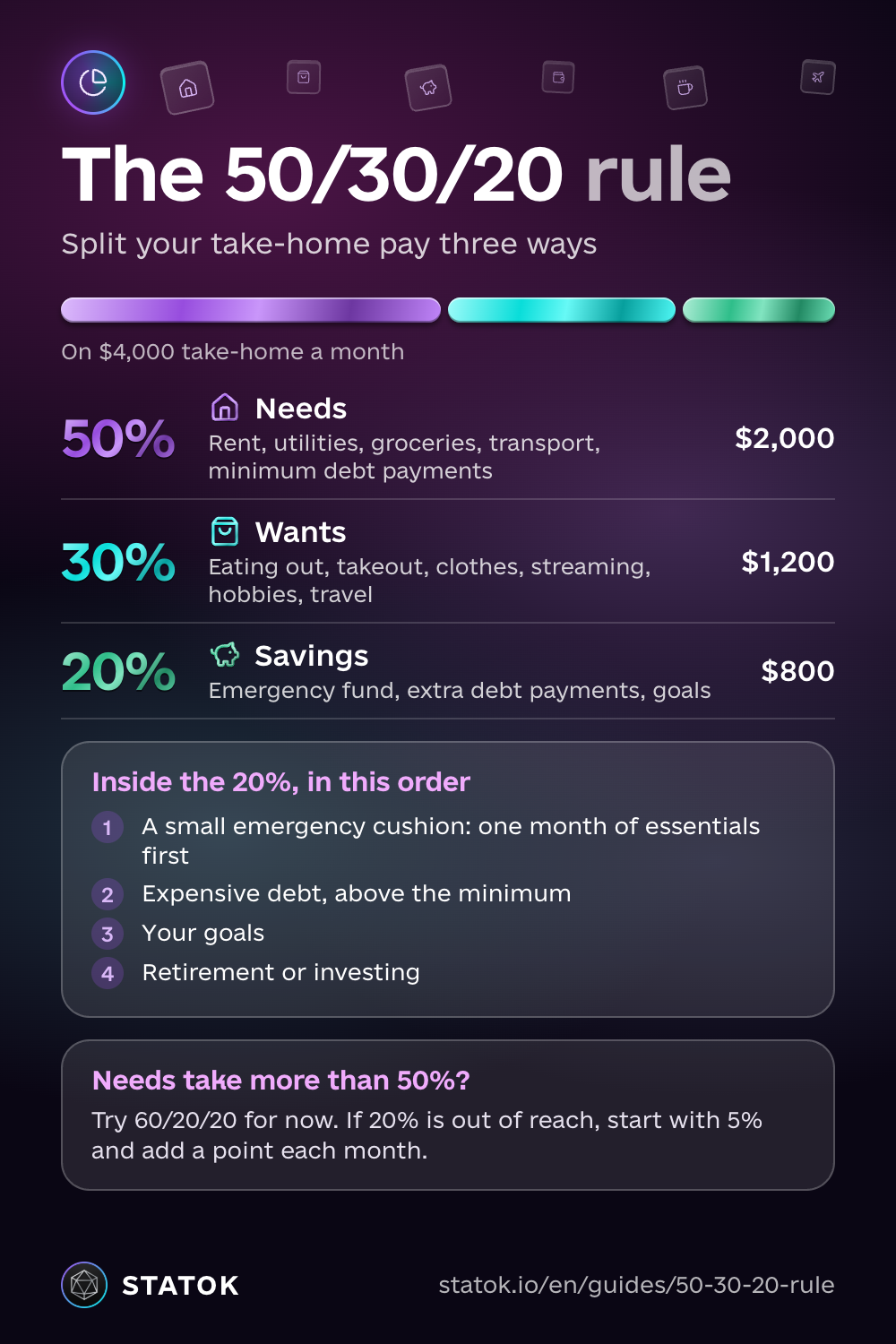
Here’s how to use the 50/30/20 rule with real numbers. Say you take home $4,000 a month:
| Bucket | Share | Per month |
|---|---|---|
| Needs | 50% | $2,000 |
| Wants | 30% | $1,200 |
| Savings | 20% | $800 |
The plan is the easy part. The useful step is checking it against what you actually spent last month.
What counts as needs, wants and savings
Needs are the bills you can’t skip or cut quickly: rent or mortgage, utilities, groceries, getting to work, insurance, medicine, phone, and the minimum payments on any debt.
Wants make life better but could pause for a month: eating out, takeout, clothes beyond the basics, streaming, hobbies, travel.
Savings covers your emergency fund, money for a goal, retirement contributions and anything you pay on debt above the minimum.
Inside the 20%, go in order: first a small emergency cushion (one month of essentials to start, then build toward three to six), then extra payments on expensive debt like credit cards or an overdraft (the debt snowball or avalanche method is one way to decide which to tackle first), then your goals, and retirement or investing after that. A card balance you only pay the minimum on keeps costing interest every month, which is why it comes first.
The awkward ones
- Debt. The minimum payment is a need. Extra payments go in the 20%.
- Subscriptions. Phone and internet are needs. Streaming, music and apps are wants, and they are often the easiest place to free up money. Here’s how to find and cancel the ones you forgot about.
- Gifts and donations. The rule doesn’t cover them. Take them from wants, or set a fixed amount aside on payday and split the rest. Pick one approach and keep it.
- Groceries vs. eating out. Groceries are a need. The fancy cheese and the delivery fee are wants. Roughly right is enough here.
How to use the 50/30/20 rule on your own pay
- Start with your take-home pay. Use what actually arrives each month. If you have more than one income, add them up.
- Multiply by 0.5, 0.3 and 0.2. On $3,200 that’s $1,600, $960 and $640.
- Add up your fixed needs. Rent, utilities, groceries, transport and minimum debt payments. If the total fits under the first number, the plan works as is. If it doesn’t, skip to the section on needs over 50%.
Check last month’s real split
Planning is the easy half. To see where you actually stand, you need a record of the last 30 days. If you don’t have one yet, start with tracking your spending and come back in a month.
- List every expense from the last 30 days and tag each one: need, want or savings.
- Work out each bucket’s share of the income from the same 30 days.
- Find the bucket that’s furthest off target and change one thing. Just one.
A common result: wants at 40%, savings close to zero. That’s not a failure. It’s the starting point, and now you know which number to move.
When needs take more than 50%
In expensive cities, rent alone can take half of a typical paycheck. Then a strict 50/30/20 split isn’t realistic, and the ratios can bend.
First, check which needs are really fixed. Phone plans, car insurance and internet can often be cut with one call or a switch at renewal, and a transit pass usually beats rideshares. Take one bill a month. Rent is the biggest lever but the slowest one: a roommate, or a cheaper area when the lease is up.
Try 60/20/20 for now
Give needs 60%, wants 20% and keep savings at 20%. On $4,000 that’s $2,400, $800 and $800. Move back toward 50/30/20 when your income goes up or your rent comes down.
If needs take even more than 60%, cover them first and save what you can, even $20 a month. If your pay no longer covers needs and minimum payments, or you’ve already missed one, don’t borrow to fill the gap. Get help early: the CFPB explains how to find a reputable nonprofit credit counselor, and in the UK the MoneyHelper debt advice locator finds free, confidential advice.
Pay yourself first
On payday, once rent, bills and minimum payments are covered, move your savings before you spend on anything else. Then spend the rest on needs and wants without tracking every percent. If 20% feels like too much, start at 5% and add a point each month.
To keep your 30% for wants from running out in the first week, turn it into a daily number. Here’s how to work out what you can spend today.
How STATOK does it
STATOK has a ready-made 50/30/20 rule card. In the Aura chat, open Aura tools and pick 50/30/20. The card shows your income over the last 30 days, how much went to Needs, Wants and Savings against each target, how each share moved compared with the 30 days before, and the biggest categories in each bucket. The card is available on the free plan. Asking Aura to explain it in chat uses an Aura message, and those are limited per day on Free (unlimited on Pro).
The standard categories are already sorted: Food, Transport, Rent & Utilities, Healthcare, Education, Pets and General Services count as needs; Restaurants, Shopping, Entertainment, Personal Care and Travel count as wants. Charity & Donations, Transfers and Other stay out of the split and show up under Exceptions outside the rule. Any category of your own in that list can go into a bucket with one tap. Savings is whatever’s left of your income after spending, plus any categories you’ve put in Savings yourself.
Two conditions. STATOK needs your income recorded, or there’s nothing to split yet. And if most of your spending sits outside the rule, the card says the shares are rough.
You don’t have to type every purchase: log spending by voice, by scanning a receipt, by importing a statement, or let iOS Shortcuts log iPhone payments and bank notifications (iOS 27). For your 20%, set up a goal under Goals and set “Remind me to contribute” to Monthly (the free plan limits how many goals you can have).
Read next
- How to build an emergency fund: the first thing your 20% goes to.
- How much can I spend per day: turn your 30% for wants into a daily number.
- How to track your spending: the 30 days of records you need to check your real split.
- How to calculate your net worth: the savings slice of your budget is what grows this number over time.
Save this guide
Download as an image Download as an image Download as an image